Also known as kdm or kdm.restech.unsw.edu.au.
If you need to copy, move, compress, or extract data to or within the Katana cluster, use the Katana Data Mover (KDM) server rather than the cluster head node. KDM is designed to handle many and/or very large transfers without impacting the login/head nodes.
You can log in to the KDM server using SSH just like you do with Katana:
ssh z1234567@kdm.restech.unsw.edu.au
Once connected you can use standard Linux commands (cp, mv, rsync, tar, etc.) to manage files on the cluster.
Why use KDM?
- KDM is built for data transfers — it avoids overloading the head nodes.
- It supports robust tools (rsync) and GUI clients (FileZilla, WinSCP) for large transfers.
- For small files (e.g. a few job scripts <2–3 MB) you can copy directly to Katana, but please keep such direct copies minimal.
Note
We require large or frequent data transfers to go through the KDM server. If you are only moving a couple of tiny text files, copying directly to Katana is acceptable but keep it small.
Transfer Methods Overview
Choose a method depending on your local machine and preference:
- Linux / macOS (command line):
rsync(recommended) orscp - Windows: WinSCP or FileZilla (GUI clients)
- All platforms: SSH into
kdm.restech.unsw.edu.auand use command-line tools
Warning
Some antivirus vendors flag FileZilla as a potential risk. If that happens, try WinSCP (Windows) or use rsync from the command line instead.
File transfer with GUI Client (FileZilla) — Recommended
FileZilla on Windows and MacOS (quick steps)
- Install FileZilla (or WinSCP).
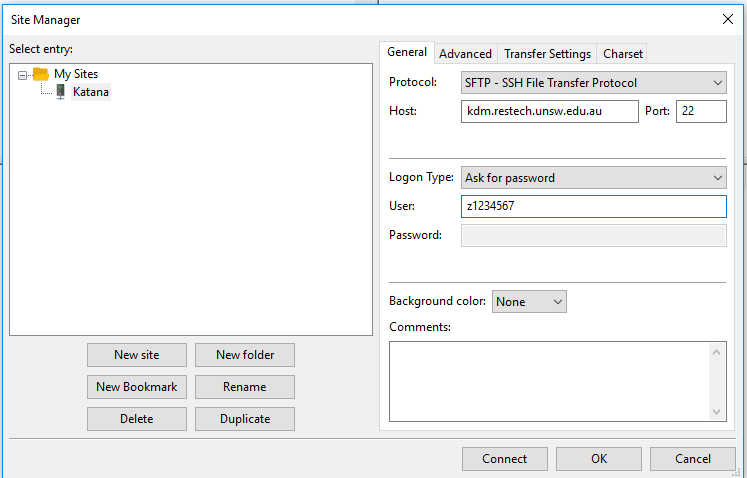
- Open Site Manager in FileZilla and create a new site:
- Host:
kdm.restech.unsw.edu.au - Protocol: SFTP - SSH File Transfer Protocol
- Logon Type: Normal (use your zID and password)
- User:
z1234567 - Connect — you should see the remote filesystem for your Katana account. Drag-and-drop to transfer files.

File transfer with command line (rsync)
Important: Use
rsync -avhfor readable progress and to preserve file attributes.The trailing colon
:after the username/host is crucial when copying to your home on KDM — it tellsrsyncthat the target is a remote directory, not a local file.rsync is preferred over scp for large or numerous files due to its efficiency and ability to resume interrupted transfers.
rsync can be included in your scripts for automated data transfers.
It can only copy unmodified files, saving time and bandwidth.
Understanding Local and Remote Paths
Before using rsync, you need to correctly define your local path and remote path.
Local path: the directory or file on your own computer.
Examples:
- /mnt/data/results/output.csv (an absolute path on Linux or Mac)
- C:\Users\Me\Desktop\file.txt (an absolute path on Windows)
Remote path: the location on the KDM server.
- Home directory → z1234567@kdm.restech.unsw.edu.au:
- Scratch directory → z1234567@kdm.restech.unsw.edu.au:/srv/scratch/z1234567
Make sure the directory exists before running rsync. If it doesn’t, you can create it on KDM with mkdir -p /srv/scratch/z1234567/myfolder.
From my computer to Katana Home
Note
When trying to copy files from your local machine to kdm.restech.unsw.edu.au, ensure using a new command line terminal (e.g., Command Prompt, PowerShell, Terminal, etc.) on your local machine. Do not run the rsync command from within an SSH session connected to kdm.restech.unsw.edu.au.
Copy your local directory /path/to/my-directory to your Katana home on KDM:
rsync -avh /path/to/my-directory z1234567@kdm.restech.unsw.edu.au:
The trailing : tells rsync to place files inside your remote home directory (e.g., /home/z1234567).
From my computer to Katana Scratch
Copy your local directory to your Katana scratch area:
rsync -avh /path/to/my-directory z1234567@kdm.restech.unsw.edu.au:/srv/scratch/z1234567/
The explicit path ensures your files go to the scratch storage instead of your home directory.
From Katana (KDM) to my computer
If remote data is in your home on KDM:
rsync -avh z1234567@kdm.restech.unsw.edu.au:my-remote-results /home/me/
If remote data is in scratch on KDM:
rsync -avh z1234567@kdm.restech.unsw.edu.au:/srv/scratch/my-remote-results /home/me/
In these examples, /home/me/ is the destination on your local computer.
Tips for Large/Long Transfers
-
Keep rsync running even if your SSH disconnects:
Usetmuxorscreenon KDM to protect long sessions. -
Resume interrupted transfers:
Use--partialand--progress(or-P) so rsync doesn’t restart from scratch.
Example:
rsync -avhP --partial /path/to/largefile z1234567@kdm.restech.unsw.edu.au:/srv/scratch/z1234567/
- For very large datasets:
Compress the folder before transfer to reduce small-file overhead:
tar -czf mydata.tar.gz /path/to/my-large-folder
rsync -avh mydata.tar.gz z1234567@kdm.restech.unsw.edu.au:/srv/scratch/z1234567/
Then, extract it on KDM:
tar -xzf mydata.tar.gz
Mounting University-provided Storage on KDM
If your project has access to university staff storage, you may be able to mount or access that storage from KDM. See UNSW's staff storage documentation for details and eligibility. If you need help, contact your local IT support or Research Technology Services.
Useful links:
Quick Troubleshooting
- Authentication fails: check you are using your zID and zPass; if using keys, ensure your public key is in
~/.ssh/authorized_keys. - Slow transfers: try using
-z(compression) with rsync for compressible data; check network conditions. - Permission errors: ensure you have read/write permission on source and destination paths.
- Antivirus warnings with FileZilla: try WinSCP or command line
rsyncinstead.